Hudson
Products
Fin-Fan®
Air-Cooled Heat Exchanger
"Frequently
Asked Questions" :
 |
How
do I specify fouling factors for an air cooler? |
Usually a fouling factor is only included for the
process side of the cooler. The airside is usually considered clean
service, although some customers will specify an airside-fouling factor
as a result of airborne contaminants. The fouling factor is actually a
resistance to heat transfer and is actually added to the other
resistances due to the heat transfer coefficients.
It is usually recommended that the resistance due to fouling
factor be no more than 33% of the total resistance to design the heat
exchanger, otherwise the heat exchanger ends up being designed for
fouling rather than for heat transfer coefficients. Some customers
specify fouling as a "not to exceed %" of the total area.
 |
How
do you select the design air temperature for
your cooler? |
The design air temperature is not exactly the maximum air
temperature during the year. Many air-cooled heat exchanger designers
recommend that the design air temperature is the one that is only
exceeded 2% of the days of the year.
 |
What
is less expensive, air coolers or water coolers? |
Plants, in general, never have enough cooling water. Water users at
the plant always exceed the supply. A water cooler will almost always be
less expensive and smaller than an air-cooled heat exchanger. However,
there may be cases when, because of the process temperature involved,
the film temperature of the cooling water becomes excessive and water
causes excessive fouling in the water system. In these cases, the use of
an air cooler is recommended.
 |
When
are belts or gearboxes used in air coolers? |
Belts are usually used in drives up to 50 HP motors. Gearboxes are
recommended for motors in excess of 50HP.
 |
How
do I specify the pressure drop for an air cooler
process side? |
For gas coolers or condensers, the pressure drop is usually limited
to 2 psi. For liquid coolers, the pressure drop is usually limited to 10
psi for an economical design. If the process fluid has a high viscosity,
then the allowable pressured drop may be specified up to 20 psi or
greater depending on pumping capacity and power consumption.
 |
What
is a guideline for the maximum design pressure
of an air cooler? |
Air coolers can be designed for up to 15000psi or more.
 |
What
is the limit on the width of the air cooler? |
There is no limit on the total size. However, there is a limit on the width of one bay and height
during transportation as restricted by roads and bridge heights.
Most manufacturers limit the width of one bay to 16 ft., which
often coincides with the maximum 50HP belt drive system.
 |
What
is the limit on the length of an air cooler bay? |
The
maximum length of the tubes available limits its. Mills
usually limit tube size to 60 ft.
 |
What
is the difference between seal weld and strength
weld of tubes in an
air cooler? |
Seal weld is usually performed to avoid leaks of process fluids to
the atmosphere. Strength weld is usually specified for high-pressure
units and it is controlled by ASME.
 |
What
is the maximum number of rows that air coolers
can be designed with? |
Air coolers can be designed with up to 16 tube rows finned and in
bare tube cases designs have utilized over 20 rows.
 |
How is the tube
thickness specified for an air cooler? |
The design of an air cooler is dictated by API 661, which specifies
minimum thickness for tubes depending on the tube material.
 |
What
is the limit on the outlet air temperature for an air cooler? |
The fan blade material usually limits this air temperature, grease
system or bearing. 220 F is
a conservative guideline.
 |
What
is the maximum number of passes on an air cooler? |
There is no limit. Air coolers can be designed with up to 10 or
more passes.
 |
What
tests can be specified to make sure that a new air cooler does not
leak? |
Submerged bundle air tests, halide testing, hydro testing, and soap
testing.
 |
When
is the use of a split header recommended? |
A split header is recommended when the difference between the inlet
and outlet process temperature is such that the tubes in the tube bundle
are subject to different thermal expansion that may cause a tube to
loose contact with the tube sheet.
 |
When
are extruded serrated fins recommended? |
Extruded serrated fins are recommended to improve the heat transfer
coefficient on the airside by causing turbulence. This is beneficial
when a compact (small) unit is needed because of available plot plan.
Extruded fins are an excellent option when alloys (tubes and headers)
are specified, in order minimize the cost of the unit.
 |
What
standards govern the design of air-cooled heat exchangers? |
API-661, ASME Section VIII notably appendix 13 for header design,
ISO 13706
 |
What
constitutes the most economical cooler design? |
Usually the longest narrowest design possible meeting API -
661requirements for fan coverage
 |
What
component contributes the most to the noise
generated by a fin-fan
cooler? |
Fan speed.
 |
Are
multi-blade fan designs the solution to noise problems? |
Not necessarily, since the most efficient fan
system utilizes the least number of blades.
It is therefore preferable to have a minimum of wide cord airfoil
blades versus a number of narrower blades.
 |
For
the average air-cooled exchanger, what is the largest practical fan
diameter to be considered? |
As a rule of thumb, 16' usually is the limit allowing the usage of
economical drive systems under 50HP.
 |
Are
their designs of fin tube that will help reduce the overall size of
the cooler plot layout? |
Using extruded serrated fins on airside sensitive designs can
greatly reduce cooler bank sizing.
 |
What
standards are available for guidelines for performance testing? |
ASME PTC-30.
 |
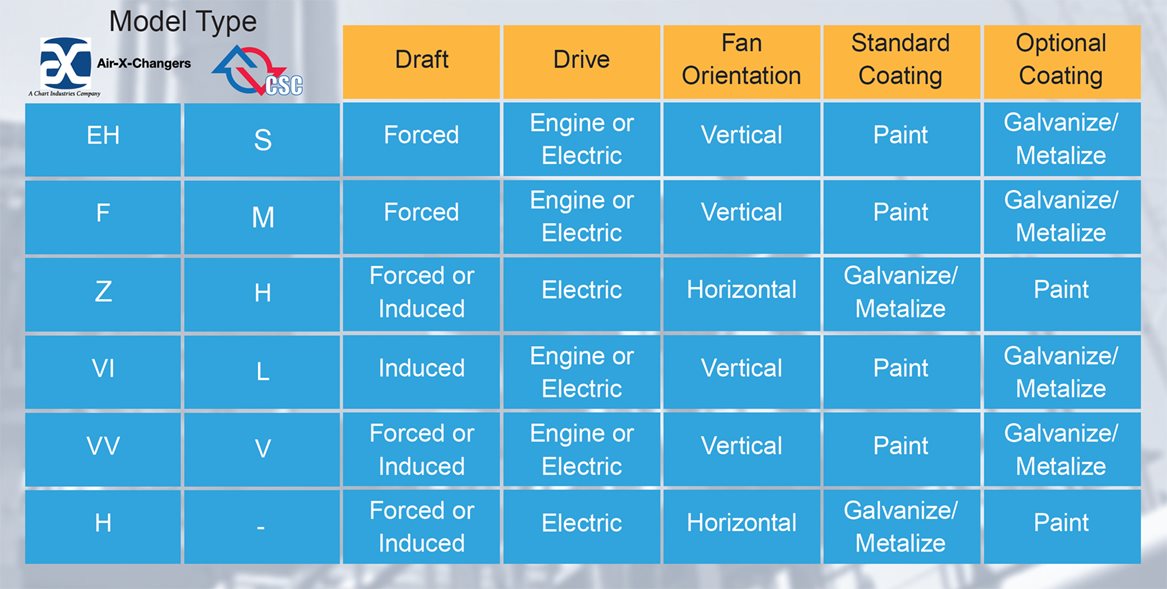
What
are differences between induced and forced
draft fans? |
- cost about the
same
Induced:
- better air distribution across the bundle
- less like to suffer from hot air recirculation
Forced:
- marginally less power consumption
- easier to maintain and to install over the side recirculation
systems
 |
Can
I use the top louvers to control the process and the
inlet and
recirculation louvers to control the plenum temperature on a
winterized unit? |
This creates an unstable system.
It is better to let the louvers control the plenum temperature
only with a VFD or auto-variable fan controlling the process
temperature.
 |
Is
a one-pass design recommended for a low-pressure
steam or process
condensing service? |
Single pass condensers are subject to vapor locking and corrosion
in the bottom (coolest) row due to the temperature and hence pressure
gradient created as the air passes
through the bundle. This causes condensate backup in the bottom
row and should definitely not be used.
 |
What
is the lowest delta T attainable with an air-cooled exchanger? |
As the outlet process temperature approaches the inlet air
temperature the unit size increases disproportionately.
The is dependent upon the thermal conditions but approaches less
than 15 F should raise a flag.
 |
The
API-661 allowable piping loads are not adequate to
meet my piping
design. Can they be
increased? |
It is not uncommon to design coolers to support piping loads of 2 -
3 times the API allowables.
 |
What
governs the design of the structural steel
supporting the cooler? |
This is commonly the most under designed
portion of the cooler when it should be the most conservative.
Local building codes usually are specified to ensure member
sizing meets local structural requirements along with the stipulation
that the design be authorized by a certified registered structural
engineer.
 |
What
is the best system to clean an air-cooled
exchanger on the fin side? |
Please see our cleaning page and recommended solutions on this
website.
 |
Should
I use a VFD for process control? |
VFD pricing has come down significantly in the recent past and is
an excellent system for process control and allowing full usage of all
available motor power during hot summer ambients.
 |
What
are the basic differences between API -661 and non-API coolers? |
Sample differences required for API:
- tube diameter minimum 1"
- geometry with regards to fan proximity to bundle
- temperature limitations for considering split headers
- lateral movement allowance of bundle
- sloping on multi-pass condensers
- header velocity limitations
- minimum header material thickness
- minimum nozzle dimensional tolerances, and maximum allowable
nozzle loads
- tube gauge minimums
- restrictions on fan capacity, tip speeds, and motor minimum
sizing
- natural frequency, vibration limitations
- minimum specifications on mechanical design of transmission
components
- louver minimal construction specifications
- limitations on structural steel design, loads, and construction
- minimum restrictions on welding procedures
-
specified noise
measurement criteria and guidelines for winterization
 |
What
are the most common problems in cooler non-performance? |
-
poor thermal
design, insist on third party check rating, or onsite performance test
in accordance with ASME-PTC-30
-
L-Base wrap on
fin separation creating gap resistance between fin and tube
-
commonly
overstated fan efficiencies, insist on air side performance tests
-
hot air
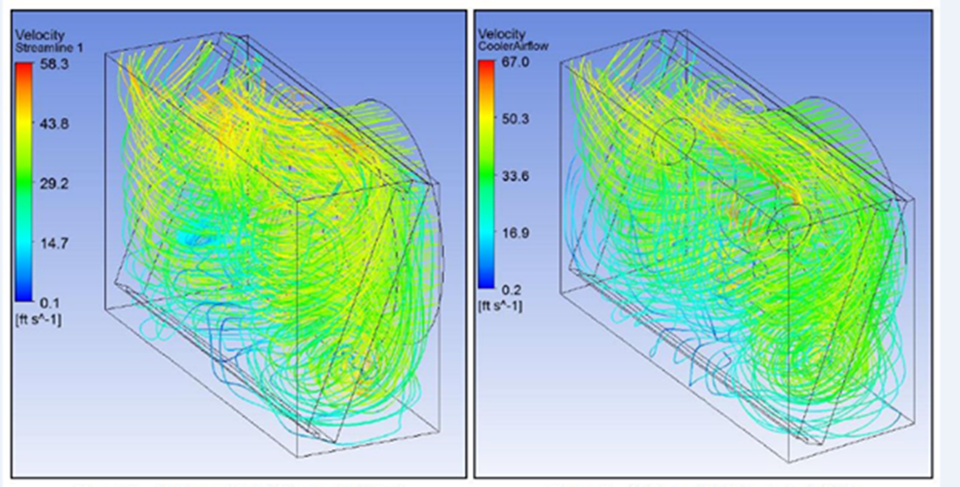
recirculation off the top to the inlet of same or neighboring
cooler
- request
computational fluid dynamics analysis when laying out the plant, watch
high intake velocities
- under
estimating the air side fouling factor due to airborne contaminant
- excessive tip
clearances between fan in fan ring
-
the absence of
inlet bells to the fan ring for efficient air entry to the fan
-
system freezing
of process fluid
-
insist on maximum side recirculation duct face
velocities and adequate instrumentation
 |
How
do I control sub-cooling in a condenser? |
In order for an air cooled liquid cooler to function properly, the
inlet and outlet piping must be arranged in a way that ensures the
flooding of the entire volume of the tubes.
If the outlet piping is connected to a tank whose liquid level is
below the level of the exchanger, and no loop seal is used to trap the
liquid, the liquid will not fill the tubes, and will run out before the
expected cooling takes place. Also
if no provision is made for venting gasses from a high point of the
exchanger or piping, it will be difficult or impossible to purge gasses
from the exchanger, and again the expected cooling will not be achieved.
Both of these problems are aggravated when one attempts to use a
single tube bundle for both condensing and sub-cooling.
In theory, any tube pass consisting of only one row of tubes
which is sloped in the direction of flow could be wholly or partially
flooded with a properly designed liquid level control, but this may not
be practical. Airflow
control is normally used to maintain a constant condensing pressure and
temperature. Therefore, as
tubeside flow and ambient air temperature change, the liquid level and
the extent of flooding would have to be adjustable in order to maintain
a constant amount of sub-cooling.
Air cooler passes are seldom sloped more than 0.125" per foot.
For an average sized exchanger, say 10' wide by 30' long, if it
were determined that an acceptable range of sub-cooling would be
achieved by flooding between 10' and 14' of the bottom row, then the
range of variation in the liquid level would have to be 0.5" or
less. This would be
difficult to accomplish in an exchanger of this size.
Increasing the slope of the tubes would add to the cost because
the tube bundle gets deeper, and supporting the tubes becomes more
difficult. If automatic
variation of the flooding were required to compensate for changes in
tubeside flow and ambient temperature, the cost of such a control system
might be higher than the cost of simply using a second tube bundle for
the sub-cooling, in which case separate air flow controls could be use
for the condensing and for the sub-cooling tube bundles.
Problems with venting further complicate the design and operation
of a condenser / subcooler tube bundle.
Even in highly pure, single component processes, some small
amount of non-condensable gas is usually present.
And when this is not the case, the exchanger will still be filled
with air or nitrogen at startup. If
a whole row is flooded, gas can be vented at the header entrance to that
row, but the degree of sub-cooling will not be controllable.
And if over cooling of the condensate is acceptable, then
increasing the vertical separation between the bottom row of tubes and
the next row up would make the liquid level less critical.
However, in the above example, the last 16' of the bottom row
would be wasted. If only
part of a row is flooded, it is impossible to vent gas from the middle
of the tubes.
For the above reasons, Hudson Products recommends that separate
tube bundles be used for condensing and for sub-cooling, and that their
piping be arranged so that none the condensing bundle and the entire
sub-cooling bundle is flooded. The
system can be vented at the condenser's outlet, at the sub-cooler's
inlet, or at both places. The
bundles may be combined in a common bay, and share fans, plenum and
substructure. If a single
bundle is used, Hudson cannot guarantee that the desired amount of
sub-cooling will be achieved.
 |
What
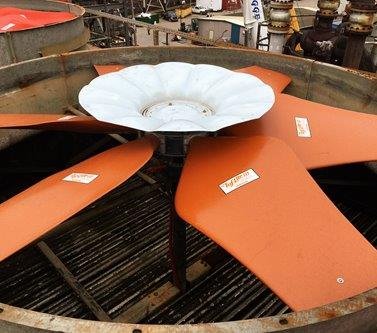
are the rivets for on the Hudson Tuf-lite II blades? |
They
are only used to secure the blade while the epoxy cement is permanently
bonding the blade to the hub section. They are not necessary for
any strength requirements. However, they should not be intentionally removed as
this would create a hole for moisture entrance. In addition, it could
affect the balance of the blade.

Home
| About Us | Products / Services
Contacts | News
| Links
Copyright © 2002 Hudson
Products Corp. All rights reserved.
Send suggestions & comments to: webmaster@hudsonproducts.com.
|