

Hudson
Products
Tuf-Lite®
and Tuf-Lite II®
"Frequently
Asked Questions" :
 |
What
is blade pitch and why is it important?
Blade
pitch is the manufacturer's recommended degree angle of attack from
the blade's horizontal
axis and is the optimum angle that will load the motor to provide
the amount of air required to perform the cooling specified.
Note:
This does not mean that the full load horsepower of the motor is
being utilized). |
 |
How
and where do you set the blade pitch on Hudson fans?
Pitch
angles on all Hudson fans are set approx. 1"-2" from the
tip of the blade using a protractor
that rests on a flat bar that extends across the leading and
trailing edges of the blade.
The protractor must be of a type that reads angles in degrees from
horizontal. |
 |
What
is blade tracking and why is it important?
Blade
tracking requires lifting of the blade tip during installation to
ensure that all blades are
in the same horizontal plane with the other blades in the assembly.
Blade tracking is set
at the same time as pitch. Poor tracking is one of the major causes
of fan vibration. |
 |
What
is the seal disc and why is it important? |
The
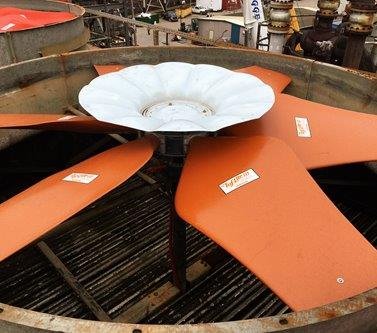
fiberglass seal disc is installed on top of the fan hub and helps
prevent hot air recirculation back
through the middle of the fan system. The seal disc adds approx.
5%-8%
efficiency to the fan performance.
 |
What
is the inlet bell and why is it important? |
The
inlet bell consists of several segments of formed fiberglass that are
installed below the
fan to shape the air flow and reduce turning losses due to the abrupt
corners in fan rings.
This shaped air flow improves air distribution and fan efficiency.
 |
How
does excessive tip clearance affect fan performance? |
Excessive
or irregular tip clearance causes uneven blade tip loading, reduced air
draw, hot
air recirculation and repetitive vibration. Tip clearance between the
blade tip and the fan
ring should be a min. of 3/8" to a max. of 3/4" per API-661.
Articles are available on our website.
 |
How
can I reduce my excessive tip clearance problem? |
Refer
to this website for Tip Seal retrofit materials or call Hudson at
1-800-634-9160.
 |
What
type of oil should be used in Hudson's Auto-Variable fan hubs? |
We
recommend Aprovis 55 synthetic oil, available through Hudson. Contact
Hudson for comparable
substitutes at
1-800-634-9160.
 |
What
are the proper torque values for the blade clamp bolts? |
It
depends on the fan diameter and the fan hub being used. Refer to our
installation manuals
on this website or call Hudson at 1-800-634-9160.
 |
Is
there a quick check list that may assist in trouble shooting
vibration problems? |
Yes.
Most vibration problems can be traced to blade tracking, blade pitch
settings, belt and sprocket alignments, structural looseness and/or
bearing wear. Refer to our installation manuals on this website or call
Hudson at 1-800-634-9160.
 |
How
often should we grease the fan and motor bearings? |
Every
Customer and plant location will differ somewhat and there is no
substitute for a well executed Maintenance Program. Refer to our
recommended Lubrication Schedules on this website or call Hudson at
1-800-634-9160.
 |
My
cooling tower fan blades have pits in the leading edges. What causes
this? |
Cooling
tower fill gets blocked by algae growth, etc., which leads to air flow
restrictions in different quadrants under the fan. Areas that have more
air flow allow water droplets to become entrained with the air flow.
These droplets impact and erode the leading edge.
 |
What
are the rivets for on the Hudson Tuf-Lite II blades? |
They
are only used to secure the blade while the epoxy cement is permanently
bonding the blade to the hub section. They are not necessary for
any strength requirements; however, they should not be intentionally
removed as this would create a hole for moisture entrance in addition to
affecting the balance of the blade.
 |
What
is the difference between a Tuf-Lite series "B" blade vs.
the "BH" blade? |
Prior
to mid 1976, the Tuf-Lite "B" blades & "C"
blades were just that B & C. After extensive field testing,
Hudson Products saw the need to strengthen certain blades with
additional cloth to the leading edge side of the blade; therefore, the
letter "H" was added to the part number indicating a slightly
heavier blade.
NOTE:
This does not apply to the following blade sizes:
T-6B,
T-7B, T-8b, T-9B, T-10B, T-16B, T-18B, T-20B & T-22B
"CH"
should apply to all the "C" blades.
|